

The modern era has granted history a platform beyond the archives through its permeation of digital media. This format has democratised access to historical fact to create one of the most accessible educational resources in contemporary times. However, this accessibility is often accompanied by enduring scepticism concerning video games as a medium of history, largely stemming from concerns regarding their historical legitimacy and the academic privileging of ‘traditional’ written history over public forms. These views are evident within debates surrounding several games categorised as ‘historical’ games such as the Battlefield series (see here), Crusader Kings (see here), as well as the Assassin’s Creed franchise. This article will explore Discovery Tour by Assassin’s Creed: Ancient Egypt (hereafter referenced as Discovery Tour) to investigate the potential gaming has as a pedagogic tool.
Edward Linenthal’s view sheds light on the prestigious merit granted to ‘traditional’ academic historians in comparison to public historians who are ‘indeed on the firing lines’ as video game developers face the ongoing challenge to produce media that simultaneously educates and entertains – something Discovery Tour arguably achieves (Linenthal, 1997, 45).
However, to successfully conduct an impartial investigation into the educational and historical value of Assassin’s Creed Discovery Tour, the delicacy of the definition of ‘historical fact’ must be addressed. Although the word ‘history’ itself (derived from the ancient Greek word historia) translates to ‘witness’ and ‘enquiry,’ it has been argued that ‘historians have never told the truth’ as personal bias interferes with their written output (Cartledge, 1995, p. 75). It has been argued that ‘consciously or unconsciously, they tell stories in the sense both of fictions and of ‘loaded’ narratives,’ suggesting that all history is personal and affected by the prejudices of the writer; therefore, how can we as the audience truly determine what is fact or fiction, as perhaps ‘history means interpretation.’ (Cartledge, 1995, p. 75 & Edward H. Carr, 1961, p. 23).
This article seeks to demonstrate that ‘the Discovery Tour can be used to link entertainment with education’ (Poiron, 2021, p. 84) and therefore video games can hold educational value. The limitations of gaming formats as pedagogic tools will be addressed through the acknowledgement of the polarising assumptions that game developers either produce completely fictional depictions of reality for entertainment value as well as addressing the tendency for consumers to place reliance on the content being the entire historical truth. Instead of players taking the ‘history presented in [video games] for granted,’ this article will investigate the potential games have to shape historical understanding and prove their ability to ‘function as a platform to teach about the past in a critical, yet fun way,’ using Discovery Tour to explore this (Boom, et. al., 2020, p. 28).
What is Assassin’s Creed Discovery Tour?
Challenging the claim that video games ‘exhibit strong popular appeal and economic relevance’ yet are ‘contrasted by a lack of cultural prestige and scientific coverage,’ this paper formally introduces Ubisoft’s Discovery Tour by Assassin’s Creed: Ancient Egypt (Reichmuth & Werning in Boom, et. al., 2020, p. 29). Firstly, it is necessary to acknowledge that the Assassin’s Creed franchise in which the Discovery Tour developed from is ‘a work of fiction’ (Bernard, 2012), although these fictional characters evolved ‘in a historical context that is as close as possible to reality, and that is supported by serious research’ (Bernard, 2012). For those unfamiliar with Assassin’s Creed, the core fictional narrative revolves around ongoing conflict between human free will and the forces trying to control it, though this serves as the ‘entertainment’ factor of gameplay (more can be read here about the storyline). To swiftly summarise, the centuries-long conflict between the Assassins (fighting for individual freedom) and the Templars (establish peace through controlling humanity) is an ideological ‘shadow’ war in which either side covertly try to eliminate the other whilst concealing their conflict from the public. Due to beliefs that humanity will inevitably erupt in chaos, the Templars manipulate financial, governmental, and technological systems to exert the ultimate restriction on individual freedom. In response, the Assassins aim to safeguard their freewill and eliminate this hidden tyranny through the selective targeting of corrupt forces that incapacitate the public. The Assassin’s maxim ‘nothing is true, everything is permitted’ exhibits the necessary skepticism required as the truth is regularly manipulated in their fictional world. Circling back to Carr’s theory of historical interpretation, this provides a parallel to the approach this article encourages historical consumers to adopt - to question the sources in front of them. Although the Assassin’s Creed fictional storyline may distort a historical truth, Discovery Tour’s vast recreation of historical settings functions as its greatest educational potential.
Ubisoft recognised this potential, and thus transformed history from something to be read about into something to be experienced on a global scale. The evolution of Assassin’s Creed’s historical legitimacy circles back to the inclusion of the ‘Animus Database,’ an in-game feature debuted in Assassin’s Creed II. This database served as an in-game encyclopaedia, incorporating both historical fact and background lore to establish a more comprehensive overview of the Assassin’s Creed universe. However, Ubisoft aimed to take this one step further and entirely eliminate fictitious elements to uncover to what extent a video game can serve an educational purpose.
Remaining true to its motto ‘history is our playground’ (Bernard, 2011), Ubisoft elevated its already historically impressive game and officially released Discovery Tour in 2018 - a game which served as a virtual museum through the removal of violence and fictional plot to explicitly focus on an educational experience through immersive gameplay.Players are granted access to four distinct historical settings from the franchise, these being: Ancient Egypt (Assassin’s Creed Origins), Ancient Greece (Assassin’s Creed Odyssey), the Viking Age of Anglo-Saxon England and Norway (Assassin’s Creed Valhalla), and Medieval Baghdad (Assassin’s Creed Mirage), successfully satisfying a player base ‘interested in history around the world’ who were now granted ‘the opportunity to learn while playing’ (Poiron, 2021, p. 79). To ensure optimal historical accuracy, Ubisoft placed historians, art historians, heritage experts, and weapon specialists ‘at the heart of the creation process’ (Poiron, 2021, p. 79).
Jeremiah McCall has strongly advocated for historians’ influence to have a heavy involvement in video games, arguing that by doing so ‘Assassin’s Creed takes the realist approach to representing the past’ (McCall, 2019, p. 31). It’s vital to recognise that the historical figures present in the Assassin’s Creed franchise as a whole, such as the inclusions of Leonardo da Vinci (Assassin’s Creed II), George Washington (Assassin’s Creed III), and Mary Read (Assassin’s Creed IV) not only provided educational value through the power of historical exposure to players, but these initial introductions served as Discovery Tour’s educational foundation. Historical credibility is paramount concerning the debate of the potential that video games have to serve as instruments of education, although as previously mentioned, a historically accurate game doesn’t guarantee that players will interpret the content as intended due to personal pre-existing understandings of the history on display. With this in mind, Discovery Tour’s credibility will be evaluated, largely focusing on the first Discovery Tour release set in Ancient Egypt.
Set in a digitally reconstructed Ptolemaic Egypt, the first Discovery Tour offers unrestricted exploration of this cradle of civilisation. The player is offered a vast seventy-five different tours within this interactive museum, which begins with the architectural appreciation and historical significance of the city Alexandria. Players are able to select their area of interest to further delve into either Egyptian culture and history, the construction process and cultural significance of the pyramids, experience a taste of daily Egyptian life, or explore the influence and presence of both Greeks and Romans. Within these tours, players are informed of all aspects of Egyptology regarding religion, architecture, mummification, and social hierarchies, as well as the inclusion of artifacts sourced directly from institutions such as the British Museum and the Louvre, like the Rosetta Stone, the Mummy Sarcophagi, and the world-famous painted limestone statue the Seated Scribe.
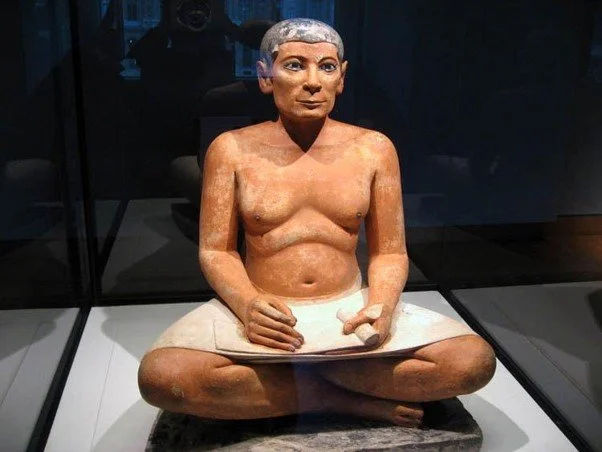
Figure 1: The Seated Scribe, c. 2600–2350 BCE. Painted limestone, magnesite, rock crystal, and copper, H. 53.7 cm. Musée du Louvre, Paris (Inv. E 3023). [Photograph] by Mindy McAdams (2016).
Rather than experiencing history from the written word of one historian, the Discovery Tour offers twenty-five different avatars to play as, meaning you can experience history from the perspective of both men and women in the ‘Ancient Egypt Fashions’ tour, of rich and poor in ‘The Houses of Egypt’ tour, or even as conqueror and conquered in the ‘The Greek Pharaohs’ tour or ‘The Siege of Alexandria.’ This experience is deliberately non-linear, granting the player control of gameplay and introducing an active way of learning through immersion and exploration. Several historians have praised this method of teaching history, stating ‘some players judged games to be more accurate than history texts to the extent that the games seemed to espouse more diverse points of view than standard historical textbooks or teachings’ (McCall, 2019, p. 36). This variety of perspectives elevates the educational value within by providing a nuanced interpretation of historical events beyond singular, dominant narratives that often prevail when researching history. Engaging with these different experiences encourages the player to develop a more critical understanding of the past, therefore exhibiting a more comprehensive depiction of the historical truth. Whilst a detailed assessment of each individual tour falls beyond the scope of this article, I encourage further investigation into each to fully comprehend the vastness of this project as an educational tool. (each individual tour can be viewed here).
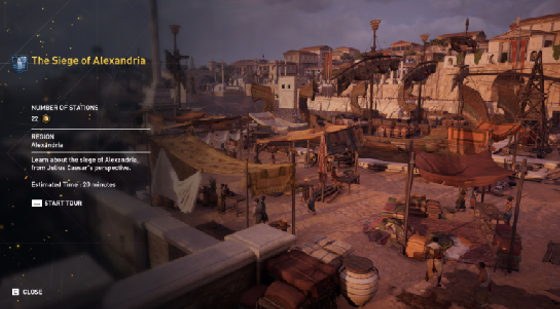
Although Ubisoft’s Team Lead for External Communications (Montreal) is eager to clarify that ‘entertaining is our main focus’ (Bernard, 2012), the educational potential of Assassin’s Creed Discovery Tour should not be hastily dismissed. Ubisoft’s partnership with McGill University led to the development of educational teaching guides (see here) to exhibit Discovery Tour as both a game and a learning opportunity. Evidence of this has been documented through several examples of its practical application in classroom teaching such as Kamphefner’s case study in which he brought Discovery Tour Egypt into his classroom (see here) which reports considerable student engagement or Judith Brisson who ‘regularly uses’ Discovery Tour Ancient Greece in her classroom to retain interest amongst young students (see here) (O’Connor, 2021). Ubisoft’s educational project integrated beyond the classroom and also into traditional museum and exhibition spaces, seen within The Muséum national d’Histoire naturelle (Paris) ‘Mummies’ exhibition which embedded a nine minute informative clip from Discovery Tour to explore the stages of mummification (see here), as well as 878 AD heritage and culture exhibition (Winchester) which combined a series of Anglo-Saxon artifacts with visuals from Assassin’s Creed Valhalla and Discovery Tour: The Viking Age (see here) to encourage broader interest.
However, there are limitations that must be acknowledged amidst its praise. Several Assassin’s Creed games prior to Discovery Tour have been critiqued for their representation of history, particularly in Christopher Magra’s review of Assassin’s Creed IV: Black Flag due to beliefs that ‘the game isn’t very historically accurate’ (Magra, 2021, p. 217). Magra identifies some of these flaws to be the condensed map that takes ‘only minutes to sail around the Caribbean’ and pirates being ‘largely apolitical,’ though subsequently acknowledges that these decisions were made to ‘appease consumer sensibilities.’ (Magra, 2021, p. 217). Scholars have brought attention to this and stated how often it is necessary to dilute history for a variety of reasons (Wright, 2022, p. 173). The creative decision to do so is a conscious decision made in Discovery Tour by Assassin’s Creed: Ancient Egypt, as Ubisoft modified recreations of historical statues to conceal their nudity ‘in order not to deprive any audience in any country from living the discovery tour experience’ (Poiron, 2021). This not only expands Discovery Tour to be a more globally accessible form of teaching by respecting cultural standards, but also ensures an appropriate way to teach within the classroom, maximising its educational potential.
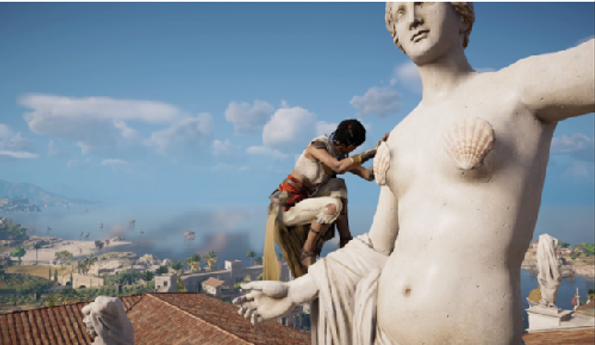
Figure 3: Censored Statue in Discovery Tour by Assassin's Creed: Ancient Egypt.
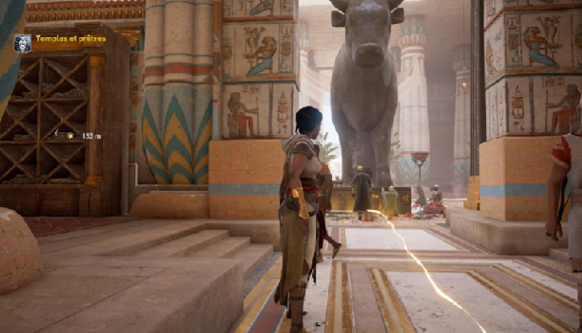
Building on Wright’s statement that Assassin’s Creed has a tendency to take creative liberty for audience accessibility reasons, (such as selecting a language that favours a contemporary Western audience in Black Flag), Discovery Tour demonstrates why this is, in fact, beneficial, rather than a ‘historical inaccuracy.’ For example, in Discovery Tour by Assassin’s Creed: Ancient Egypt, the player is granted access to the Temple of Ptah in Memphis. In Ancient Egypt however, ‘common people would not have access to this temple…even nobles were not allowed to go inside’ (Poiron, 2021, p. 83). This raises the question if strictly sticking to historical truth would be the correct way to educate a player base, as although this technically means Discovery Tour falls victim to the inclusion of ‘counterfactual history, events and outcomes that did not happen,’ it also provides ‘a sense of exploration, of control, of possibility’ instead of ‘passive determinism’ (McCall, 2019, p. 34-35). Using creative liberty to eliminate historical restriction of a sacred site such as the Temple of Ptah could instead be seen as a powerful decision that enhances accessibility and understanding of historical elements, rather than concealing them in order to comply with historical ‘truth.’
This revisits the initial dilemma of how historical accuracy is determined, an idea in which Tara Copplestone divides into three frameworks: reconstructionist history (recreating history using evidence), constructionist history (historians being selective in the history they use), and deconstructionist history (questioning the history available and exploring other perspectives). In her 2017 article, she suggests traditional historians favour reconstructionist history as it solidifies a ‘more authoritative and accurate stance upon what constitutes history’ (Copplestone, 2017). She argues that constructionist history, however, provides a more open-ended perspective of history through the incorporation of ‘metaphor or thematic and structural elements which are not dependent on photo-realism or hyper realism’ (Copplestone, 2017). This opposes the grey space of ‘historical accuracy’ within video games, as Discovery Tour is selective in its history being displayed, evident within the censoring of statues previously mentioned. Therefore, the game isn’t simply reproducing the past but instead constructing a particular version that is appropriate for its audience. The significance of deconstructionist history is given primary importance within her article, as it ‘challenges conventional notions about how we may come to form ideas about the past’ (Copplestone, 2017), a notion encouraged by Discovery Tour. Ubisoft historian Maxime Durand also explains that ‘because we’re not accurate all the time we make (creative) choices. So, this is something that is important for us…to understand that not everything they see on screen is true’ (Reparaz, 2018). Ultimately, Discovery Tour engages with all of these frameworks, and therefore isn’t required to claim objective accuracy to provide historical value. As well as recreating a digital museum of reconstructed historical evidence, this game fundamentally encourages players to question historical interpretations on screen, actively producing a global audience of more critical consumers of history. Evidence of this is available across several social media forums - see here and here to read more.
This educational potential has been recognised and successfully implemented into classrooms worldwide. History teacher Tanner Kamphefner utilised the tour to educate his 10th grade students regarding the development of Alexandria, with it being recorded that ‘the students seemed completely engrossed’ and one even stating, ‘they never would’ve answered so many [questions] had they been using a textbook’ (Maguid, 2019). Though it is paramount to acknowledge the limitations that video games ‘are mostly utilised to provide a fun experience in order to generate revenue’ (Boom et al, 2020), and therefore, like Assassin’s Creed, contain fictitious elements, or like Discovery Tour, contain personal bias in the elements selected to represent, the notion that gaming possesses educational value still holds merit. As previously highlighted, Discovery Tour demonstrates that games have the ability to transform the past merely from something to be read or viewed into something that can be explored through immersive gameplay. In-game interpretations that oppose ‘traditional’ history shouldn’t be criticised but should instead be viewed for potential to transform a player-base into critical thinkers who are actively questioning the media in front of them. Discovery Tour is ‘not competing with teachers or textbooks’ but instead ‘trying to offer an additional tool for education’ (Maguid, 2019).
To clarify, ‘’historical accuracy’ is a problematic term in-and-of itself and means different things to different people’ (McCall, 2019, 36). Therefore, perhaps Ubisoft’s greatest educational opportunity is constructed from encouragement to approach public media with a degree of scepticism, to create critical historical engagement globally and persuade players worldwide to make history their own playground. Like all historical sources, its accuracy can be questioned, though its strength as a gateway for research and interest cannot be disputed.
Further Reading
Jenkins, David. ‘Battlefield 1 interview – ‘Before we start making things up, let’s look at what history provides us,’ Metro, May 26, 2016 [Accessed 12/08/2026].
O’Connor, Daniel. ‘Keys to learn 2021 - video games and the virtual classroom,’ Ubisoft, January 29, 2021. https://news.ubisoft.com/en-us/article/3rgVWBkxxm3nv2r2xpeGex/keys-to-learn-2021--video-games-and-the-virtual-classroom?utm [Accessed 02/11/2026].
Oofsiswhy. ‘Do we need to be critical of historical accuracy in these games, or is that too much?’ Reddit. September 27, 2024. https://www.reddit.com/r/assassinscreed/comments/1fqpqjc/do_we_need_to_be_critical_of_historical_accuracy/?solution=e22c4446643b06b9e22c4446643b06b9&js_challenge=1&jsc_token=2824be10929bdc604753c70a67a1c3314c9932e1ab1e84b7b56d75201782e4ad&jsc_orig_r=&utm= [Accessed 02/11/2026].
Oyarly. ‘Assassin’s Creed Discovery Tour accuracy. How do I verify and not accept blindly?’ Reddit. January 8, 2025. https://www.reddit.com/r/AskHistorians/comments/1hwvf86/assassins_creed_discovery_tour_accuracy_how_do_i/?utm [Accessed 02/11/2026].
Purslow, Matt. ‘The complete Assassin’s Creed timeline,’ IGN, March 10, 2025. https://www.ign.com/articles/the-complete-assassins-creed-timeline [Accessed 02/11/2026].
Ubisoft. ‘All Discovery Tour curriculum guides.’
https://www.ubisoft.com/en-gb/game/assassins-creed/discovery-tour/curriculum-guide [Accessed 02/11/2026].
Ubisoft. ‘Discovery Tour: Ancient Egypt gameplay guide,’ https://www.ubisoft.com/en-us/game/assassins-creed/discovery-tour/curriculum-guide/ancient-egypt/gameplay-and-pedagody-guide [Accessed 11/02/2026].
Bibliography
Bernard, Marie, C. ‘Ubisoft responds to the Globe’s editorial on Assassin’s Creed III.’ The Globe and Mail. November 30, 2012. Available online: https://www.theglobeandmail.com/community/ubisoft-responds-to-the-globes-editorial-on-assassins-creed-iii/article5839655/ [Accessed 18/08/2026].
Boom, Krijn H. J., Csilla E. Ariese, Bram van den Hout, Angus A. A. Mol, and Aris Politopoulos. ‘Teaching through Play: Using Video Games as a Platform to Teach about the Past.’ In Communicating the Past in the Digital Age: Proceedings of the International Conference on Digital Methods in Teaching and Learning in Archaeology (12th-13th October 2018), edited by Sebastian Hageneuer, 27-44. Ubiquity Press, 2020. http://www.jstor.org/stable/j.ctv11cvx4t.8
Carr, Edward, H. What is history? London: MacMillan, 1961.
Cartledge, Paul. ‘‘We are all Greeks’? Ancient (especially Herodotean) and modern contestations of Hellenism,’ Bulletin of the Institute of Classical Studies 40 (1995): 75-82. https://www.jstor.org/stable/43646577
Copplestone, Tara, J. ‘But that’s not accurate: the differing perceptions of accuracy in cultural-heritage videogames between creators, consumers and critics’, Rethinking History 21, no. 3 (2017): 415-438. https://doi.org/10.1080/13642529.2017.1256615
Discovery Tour by Assassin’s Creed: Ancient Egypt. Ubisoft, 2018.
Jenkins, David. ‘Battlefield 1 interview – ‘Before we start making things up, let’s look at what history provides us,’ Metro, May 26, 2016 [Accessed 12/08/2026]. https://metro.co.uk/2016/05/26/battlefield-1-interview-before-we-start-looking-at-making-things-up-lets-look-at-what-history-provides-us-5905319/
Linenthal, Edward, T. ‘Problems and promise in public history,’ The Public Historian 19, no. 2 (1997): 45-47. https://doi.org/10.2307/3379140
Lundblade, Kirk, M., ‘Gods, Kings, and Historians: History and the Dual Diegesis of Crusader Kings in the Assemblage of Play.’ Paper presented at proceedings of DiGRA 2024: Authors & Digital Games Research Association of DiGRA. University of Central Florida, College of Arts and Humanities, July 1-5, 2024. https://www.google.com/url?sa=t&source=web&rct=j&opi=89978449&url=https://dl.digra.org/index.php/dl/article/download/2244/2241/2259&ved=2ahUKEwiStobMnqKWAxWmTkEAHdIVFRoQFnoECC8QAQ&usg=AOvVaw3rg6lvSDppfXpBaFVT8Fyx
Magra, Christopher, P. ‘Assassin’s Creed IV: Black Flag.’ The American Historical Review 126, no. 1 (2021): 216-217. DOI:10.1093/ahr/rhab003
Maguid, Youssef, “What Happens When Students and Teachers Go Hands-on With Discovery Tour: Ancient Greece”, Ubisoft, 20th September 2019. https://news.ubisoft.com/en-au/article/2Qdtl7NjlUPC5XO2JkJdLo/what-happens-when-students-and-teachers-go-handson-with-discovery-tour-ancient-greece [Accessed 01/10/2026].
Malik, Angad Singh, Aparna Nayyar, Garance Sarlat, and Louisa Ben Saïd. “Women in Gaming.” In The Gender Equality Quest in Video Games. 75-88, UNESCO, 2024. http://www.jstor.org/stable/resrep70569.13.
McAdams, Mindy. The Seated Scribe. 2016. Photograph. Louvre, Paris. https://www.worldhistory.org/image/5858/the-seated-scribe/
McCall, Jeremiah. ‘Playing with the past: history and video games (and why it might matter).’ Journal of Geek Studies 6, no.1 (2019): 29-48. https://jgeekstudies.org/wp-content/uploads/2019/04/5_gaminghistory.pdf
O’Connor, Daniel. ‘Keys to learn 2021 - video games and the virtual classroom,’ Ubisoft, January 29, 2021. https://news.ubisoft.com/en-us/article/3rgVWBkxxm3nv2r2xpeGex/keys-to-learn-2021--video-games-and-the-virtual-classroom?utm [Accessed 02/11/2026].
Poiron, Perrine. ‘Assassin’s Creed Origins Discovery Tour: A behind the scenes experience,’ Near Eastern Archaeology 84, no. 1 (2021): 79-85. https://www.jstor.org/stable/48745491
Purlson, Matt. ‘The Complete Assassin’s Creed Timeline.’ IGN. March 10, 2025. [Accessed 12/08/2026]. https://www.ign.com/articles/the-complete-assassins-creed-timeline
Reparaz, Mikel. ‘Assassin’s Creed Origins – Discovery Tour Q&A with Historian Maxime Durand.’ Ubisoft, February 13, 2018. https://www.ubisoft.com/en-gb/game/assassins-creed/news/46PlC3yAeikjDI652TayLm/assassins-creed-origins-discovery-tour-qa-with-historian-maxime-durand?utm [Accessed 18/08/2026].
Ubisoft, ‘Gameplay and Pedagogy Guide,’ Assassin’s Creed Discovery Tour: Ancient Egypt. https://www.ubisoft.com/en-us/game/assassins-creed/discovery-tour/curriculum-guide/ancient-egypt/gameplay-and-pedagody-guide [Accessed 19/08/2026].
Wright, Esther. ‘Still playing with the past: history, historians, and digital games.’ History and Theory 61, no. 4 (2022): 166-177. https://doi.org/10.1111/hith.12280
Cover Attributions:
Header Image Attribution: By Murat Beşbudak - Own work, CC BY-SA 4.0, https://commons.wikimedia.org/w/index.php?curid=90900458)
Left Image Attribution: By Ingo Mehling - Own work, CC BY-SA 3.0, https://commons.wikimedia.org/w/index.php?curid=18040000)
Right Image Attribution: By HALUK COMERTEL, CC BY 3.0, https://commons.wikimedia.org/w/index.php?curid=55165494)