

The ‘Beautiful Beast’: Uncovering the Violent Women of World War Two
John Keegan, in his 1993 book The History of Warfare made the claim that:
“Warfare is the one human activity from which women, with the most insignificant exceptions, have always and everywhere stood apart ... If warfare is as old as history and as universal as mankind, we must now enter the supremely important limitation that it is an entirely masculine activity.”
Yet, history shows this to be untrue. The contribution of women in warfare has been extensively researched in almost every conflict, from ancient times to the modern day. However, such contribution is often framed in a feminist lens, the phenomenon of women taking on male roles in wartime one of empowerment and progression. Viewing women’s war contribution through this lens however restricts our understanding of conflict, as it excludes discussions of women who contributed to the war via more violent means. Two such groups of women are the SS Aufseherinnen of Nazi Germany, and the female sniper squads of the Soviet Union, who contributed to the mass violence which defined the Second World War.
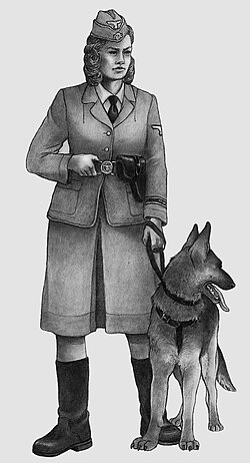
An artistic depiction of an SS Aufseherinnen.
Murder as a Masculine Ideal
From its Latin origins, the term ‘perpetrator’ means to carry through or accomplish a task by the ‘pater’ - the father. From an etymological standpoint, it is clear why so little research has been undertaken on female perpetrators of murder in conflict, the term excluding female agency within in its literal definition. Secondly, war as a concept has historically been embedded in masculinity and male actions and violence. The lives, roles and contributions of women are often pushed aside, women occupying the passive roles of wife, mother, victim, and mourner. The release of Claudia Koonz’s 1987 book Mothers in the Fatherland, and the release of historical documents after the fall of the Soviet Union in 1991, caused a rise in debate on the role of women in these oppressive regimes, and their role in the violence that defined them. In Germany, traditional histories of the Holocaust have been framed by patriarchal ideas, women unable to be perpetrators in the genocide due to their own persecution under Nazism. This was a widely accepted narrative across other nations, including women in the Soviet Union. However, Koonz was one of the first to question this, arguing that the Nazi regime was not a purely masculine endeavour, with women contributing to the killing of 6 million Jews in a variety of roles. Likewise, while the extensive mobilisation of women into the Soviet army was not entirely suppressed during the war, huge efforts were undertaken to minimise the stories of the women after 1945. Svetlana Aleksievich’s The Unwomanly Face of War, first released in 1987, shed light on these stories, exposing the darker sides of an already bloody conflict to the Soviet public.
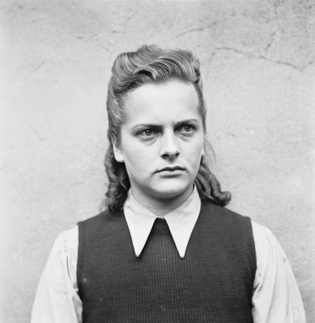
Irma Grese, awaiting trial in 1945.
The Pathway to Violence
On a surface level, the pathways for women to enter into intensely masculine occupations within an already oppressive society appear to be limited. Nazi ideology cemented women’s contributions in the movement to the domestic sphere, to focus on growing the German population to populate occupied territories through the infamous three K’s, Kinder, Küche and Kirche (Kitchen, Children, Church). On women in the workforce, Adolf Hitler proclaimed women’s inferiority constantly, working life “[placing] the woman in situations that cannot strengthen her position—vis-a-vis both man and society— but only weaken it”. Yet despite Germany’s best efforts, the outbreak of war forced Hitler to forgo his ideologies for the enhancement of the German war machine. In 1939, all single women had to report for compulsory labour service as part of Germany’s preparation for war, leading to many women being deployed throughout the concentration camp system. However, most women applied as camp guards on their own initiative, attracted by financial and social incentives. Compared to factory or domestic work, camp work offered relatively high pay, job security, and status. They also offered an escape from their everyday lives, a chance to wield some form of authority over others. Most, if not all, were unaware of the violent nature of the work they would later be carrying out when applying. In line with the strict gender regulations of Nazi ideology, women were deployed as guards to all-female camps, the largest being Ravensbrück in Northern Germany. By the end of the war, 13 female camps had been established, all staffed by women. Exact details of the number of women who were employed within the camp system are unknown, but based on available records, estimates range upwards of 3,500.
In contrast, the brutality of fighting on the Eastern Front drove Stalin to abandon his personal misogyny and mobilise thousands of women into the Red Army. David Glantz notes that determining the true number of women who served in the Red Army remains an obscure and controversial chapter in Soviet history. Simultaneously, enormous contemporary efforts were taken to mobilise these women, a contradiction deemed insignificant by Soviet officials. Unlike Germany, female combatants were not a foreign concept for Russia, with women fighting on the frontlines in the Russian Civil War and the First World War. Women’s involvement in the ‘Great Patriotic War’ can be described within the Stalinist ideology of the ‘people’s war’, and as a means for survival due to the mass casualties the Red Army suffered in the face of the 1942 Nazi invasion. Women were called to the frontlines alongside their male counterparts, Stalin appealing to the masses of willing Soviet citizens through patriotism and collective sacrifice for the Rodina (motherland). What was unique to this mobilisation was the specific mobilisation of women through the Communist Party’s Youth Division, the Komsomol, to recruit women to specialised sniper training schools. These schools trained women in the specific task of premeditated killing, a far cry from the traditional roles most women occupied during the war.
The reasoning for forming these female sniper regiments was not only a matter of necessity and survival, but was also simply honouring the wishes of mobilised women. Many women desired to take on more extreme roles in the military, over simpler roles in nursing or auxiliary services. The response by military officials was one of patriotism, communist newspaper Pravda in March 1942 reporting, “If a young Soviet woman wants to become a sniper, we should not discourage her desires.” For the USSR, the focus was on the patriotism of those wanting to serve, not necessarily their gender. As well as this, the founder of the sniper movement, Major General Morozov, argued that only women could fulfil these roles, female characteristics predisposing women to cold, calculated killing. He attributed superior female shooting to women’s more “sensitive” hands, so when shooting, their fingers pull the trigger more smoothly. Over the course of the war, gender became less and less of an issue for Stalin as snipers became more and more mythical in Soviet wartime propaganda, elevated to an almost heroic status - as demonstrated by top sniper Lyudmila Pavlichenko’s tour of Allied countries in late 1942. By 1945, up to 1 million women were serving in the Soviet army, with around 2000 of these women trained in dedicated sniper schools.
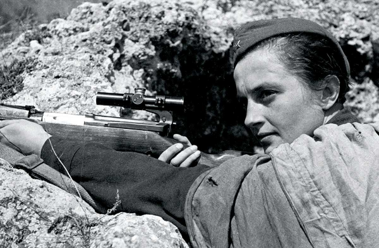
Top Soviet sniper, Lyudmila Pavlichenko.
Contribution to Mass Murder
Elissa Mailänder’s study on the Majdanek concentration camp was pioneering in its in-depth analysis of the everyday lives of the Aufseherinnen, detailing their contributions to the camps and how these women became violent. The true contributions of both the Aufseherinnen and the Soviet snipers are still very much unknown, however it is clear from Mailänder’s and Aleksievich’s work that their commitment to mass murder was extensive. Mailänder outlines a daily exercise of violence, intended to dominate prisoners and destroy them, such violence a means to communicate power and authority. Such power was not awarded to women in their civilian lives, so when given the opportunity, women wielded it the same way their male counterparts did. Beyond this, guards also selected who was to be lethally gassed, and in some cases volunteered to take part in the killing process. As well as this “workaday violence”, women contributed to murder in more extreme ways, as was the case with Irma Grese. The ‘beautiful beast of Belsen’ would become the youngest woman to be executed under British law during the 20th century at 22 years old, becoming an Aufseherinnen when she was barely 18. Grese was one of the few Aufseherinnen allowed to be armed, and in her post-war trial, witnesses described her severe and constant beatings of prisoners. While the case of Irma Grese was the most extreme, it is evidence of the everyday violent tendencies many Aufseherinnen exhibited within their roles, in both physically carrying out these acts and in selecting those to be killed.
Unlike the Aufseherinnen, snipers on the Eastern Front directly contributed to the mass casualties of German invaders. The most infamous of these snipers was the aforementioned Pavlichenko, nicknamed ‘Lady Death’ by the Germans, who tallied 309 confirmed Nazi kills by her 25th birthday. In 16 months, between 1942-43, over 2000 female snipers had contributed to the deaths of up to 20,000 Germans. While the Aufseherinnen were more indirect in their murderous contributions, they were clearly conduits of the violence and genocide that embodied expanding Nazi occupation. However, while both the Aufseherinnen and the sniper’s actions and contributions can be somewhat quantified, what is of interest to many historians is why these women committed such actions.
Motivation - ‘Sexual sadism’, patriotism, or freedom?
Jonathan Maynard, in his study of perpetrator ideologies, argues that ideology, especially those of an exclusionary nature, is a key factor in the perpetration of atrocity crimes, but is rarely the sole motivator. This focus on ideology is often used to dismiss the actions of thousands of perpetrators throughout war conflicts, but there has been a shift in recent years to look beyond this simplistic argument. Christopher Browning’s 1992 work on the Reserve Battalion 101 was influential in the field of perpetrator studies, shifting the focus from an institutional setting to individual motivations. However, this work was within an exclusively masculine worldview. With the expansion of feminist analysis in Holocaust studies, understanding the motivations of how ‘domesticated’ German women were able to willingly participate in a genocidal system has garnered greater interest. During post-war trials, the overarching view of female perpetrators was that they were able to be spared from facing legal consequences, as they were merely victims of patriarchal practices, caught up in a genocidal system as opposed to actively participating in it. The few Aufseherinnen questioned at post-war trials or in their own reflections leverage this position of victimhood to justify their actions, reflected in Alison Owings interviews of Nazi women. However Mailander and Lower contest these defences. Lower questions how we account for the extremely violent and sadistic behaviour of women such as Grese, whose actions cannot be explained away by forced state ideology or victimisation. Rather than minimise the actions of violent Aufseherinnen as insignificant cogs in an extensive war machine, contemporary scholars argue their individual motivations must be explored from a more psychological framework.
In contrast to the defensive and victim-based narrative applied to the Aufseherinnen, female snipers were fully aware of the nature of their actions. In post-war recollections collated by Aleksievich, female snipers detail in extreme detail the horrors of sniper work and the training involved, yet almost always maintain an extreme sense of duty towards the Rodina and hatred of the fascist invaders. Many vividly recall their first kills, the transition from civilian to trained assassin, a difficult one, “It was one thing to hate fascism, another to kill an individual human being”. Yet once seeing the destruction and casualties inflicted by the approaching German army, many quickly changed tact. As Yulia Zhukova recalls,
“[I] saw the evil wrought by the fascists, then I felt no regret at all for whomever I killed [...] The annihilation of the Germans simply became a chore, an obligation which I needed to do well. Otherwise, they would kill you.”
This mentality of ‘us vs them’ is common in almost all memoirs and interviews with these women, whose motivations for enlistment into the sniper training range from patriotic duty, response to enemy occupation and revenge for fallen comrades. More often than not, pure hatred motivated the women in life-or-death situations, Yadviga Savitskaia stating it was stronger than fear, with most slowly becoming desensitised over the course of the war. The obvious pride shown by these women is testimony to their convictions that their cause was just, a stark contrast to the women of Germany. The disparity between the two environments in which these women murdered and contributed to mass homicide is significant in their different explanations for their actions, but it is important to note the role of ideology and nationalism in both cases. For both German and Soviet women, the ideologies of Nazism and Stalinism play an important role in explaining why they enlisted and committed violent acts. However, the Aufseherinnen did so as a means of bolstering their own sense of power and authority in a system that would otherwise oppress them, whereas Soviet women did so out of survival and duty.
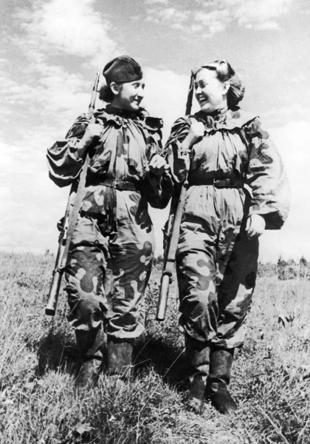
Two female snipers R. Skrypnikova (right) and O. Bykova (left) returning from a combat assignment on November 21, 1943.
Bibliography:
Primary Sources
Aleksievich, Svetlana. The Unwomanly Face of War. Translated by Richard Pevear and Larissa Volokhonsky. New York: Penguin Books, 2017.
Adolf Hitler, 1935 “Speech to National Socialist Women’s Congress,” in Nazi Culture: Intellectual, Cultural and Social Life in the Third Reich, ed. George Mosse, (New York: Grosset and Dunlap, 1966), 39.
Josef Stalin, 1941, “Speech at the Red Army Parade on the Red Square”, in J.V. Stalin Works, (London: Red Star Press, 1978), 41.
Mishakova, Olga. “Sovetskaia zhenshchina velikaia sila (Soviet Woman, Great Power).” Pravda, 8 March 1945. Cited in Pennington, Reina. “Offensive Women: Women in Combat in the Red Army in the Second World War.” Journal of Military History, 74 (July 2010).
‘Sovetskaya devushka! Ovladevai voennymi spetsialnostyami! (‘Soviet girl! Master military specialties!’)’, Pravda, 25 March 1942. Cited in Markwick, Roger and Cardona, Euridice Charon. Soviet Women on the Frontline in the Second World War. Palgrave Macmillian, 2012.
‘The Belsen Trial: Trial Of Josef Kramer And 44 Others.’ In Law Reports of Trials of War Criminals Volume 2. London: United Nations War Crimes Commission, 1947.
Zhukova, Yulia. Girl With A Sniper Rifle: An Eastern Front Memoir. Big Sky Publishing, 2020.
Secondary Sources
Alexievich, Svetlana. “‘I Am Loath to Recall’: Russian Women Soldiers in World War II”, Translated by trans. Hammond, Keith and Lezhneva, Ludmila. Women's Studies Quarterly 23, no. 3 (Fall - Winter, 1995): 78-84. http://www.jstor.org/stable/40003502.
Bridenthal, Renate. “Beyond Kinder, Küche, Kirche: Weimar Women at Work.” Central European History 6, no. 2 (1973) 148-66.
Brown, Daniel Patrick. The Camp Women: The Female Auxiliaries Who Assisted the SS in Running the Nazi Concentration Camp System. Schiffer, 2002.
Browning, Christopher. Ordinary Men: Reserve Police Battalion 101 and the Final Solution in Poland. London: Harper Collins, 1992.
Engel, Barbara Alpern. “The Womanly Face of War: Soviet Women Remember World War II.” In Women and War in the Twentieth Century, edited by Nicole Dombrowski Risser. Taylor and Francis, 1999.
Glantz, David. Colossus Reborn: The Red Army at War 1941-1943. Kansas: University Press of Kansas, 2005.
Keegan, John. A History of Warfare. New York: Knopf, 1993.
Koonz, Claudia. Mothers in the Fatherland: Women, Family and Nazi Politics. Routledge, 2012.
Krylova, Anna. “Stalinist Identity from the Viewpoint of Gender: Rearing a Generation of Professionally Violent Women Fighters in 1930s Stalinist Russia.” Gender and History 16, no. 3 (November 2004).
Long, Brittany. “Photographing the Feminine: Aufseherinnen in Holocaust Photography and Popular Culture, 1944-2018.” Honours Thesis, Carleton University, 2021.
Lower, Wendy. “German Women and the Holocaust in the Nazi East.” In Women and Genocide: Survivors, Victims and Perpetrators, edited by Elissa Bemporad and Joyce W. Warren, 111-36. Indiana: Indiana University Press, 2018.
Lower, Wendy. Hitler’s Furies: German Women in the Nazi Killing Fields. New York: Penguin Random House: 2013.
Mailänder, Elissa. Female SS Guards and Workaday Violence: The Majdanek Concentration Camp, 1942-1944. Translated by Patrica Szobar. Michigan State University Press, 2015.
Markwick, Roger and Cardona, Euridice Charon. Soviet Women on the Frontline in the Second World War. Palgrave Macmillian, 2012.
Markwick, Roger. “A Sacred Duty”: Red Army Women Veterans Remembering the Great Fatherland War, 1941–1945.” Australian Journal of Politics & History 54, no. 3, (2008).
Maynard, Jonathan Leader. “Studying Perpetrator Ideologies in Atrocity Crimes.” In Perpetrators of International Crimes: Theories, Methods, and Evidence, edited by Alette Smeulers, Maartje Weerdesteijn, and Barbora Holá, 175-91. Oxford, 2019.
Nash, Jay Robert. Look for the Woman: a Narrative Encyclopedia of Female Poisoners, Kidnappers, Thieves, Extortionists, Terrorists, Swindlers, and Spies from Elizabethan Times to the Present. New York: M Evans & Co., 1981.
Owings, Alison. German Women Recall the Third Reich. New Jersey: Rutgers University Press, 2003.
Weiss, Sheila Faith. “Review of Zwangssterilisation im Nationalsozialismus. Studien zur Rassenpolitik und Frauenpolitik, by Gisela Bock.” German Studies Review 10, no. 3 (October 1987).