

What the craze for Blackface minstrelsy reveals about British culture and society in the mid-1800s
Note: This article contains discussion of racist language and imagery.
Britain’s craze for blackface minstrelsy during the mid-1800s reveals that national identity was reinforced against racialised otherness during times of political upheaval. After the arrival of blackface minstrelsy in Britain with T. D. Rice's first Jim Crow performance in 1836, blackface minstrelsy became a popular form of entertainment, with Richard Waterhouse using print media sources to estimate that Britain was home to over fifty different minstrel troupes by 1860 (Waterhouse, 1985, p. 3). Michael Pickering believes that minstrelsy had wide appeal “among all the social classes in British society, as well as across the categories of gender, generation and geographical region” (Pickering, 2016, p. xi). Despite Michael Pickering's acknowledgement that minstrelsy was used to navigate “cultural change, involving a reaction between and creative re-assemblage of old and new,” and despite the political upheaval experienced by Britain during the nineteenth century, scholarship fails to adequately consider how politics influenced the content of British blackface minstrelsy (Pickering, 2016, p. xi). Through analysing the influence of politics on British blackface minstrelsy, this article will demonstrate that minstrelsy was used as a vehicle to reinforce British national identity during a period of political upheaval. This will be demonstrated through analysis of both international and domestic political developments which impacted Britain, using written and visual sources such as song lyrics, sheet music covers, advertisements and images of blackface minstrelsy. Firstly, this article will establish that Britishness was shaped against otherness, particularly through racialisation, prior to the British blackface minstrelsy craze. Afterward, minstrelsy's evocation of American politics and Britain's political divergence from America over slavery will be examined to show that this positioned Britain as morally superior to their transatlantic counterpart. While J. S. Bratton's analysis of blackface acts focused upon the years between 1835 and 1865, this essay focuses on the years between 1830 and 1870, allowing for a fuller consideration of British national identity prior to the arrival of blackface minstrelsy, as well as its evolution and adaption across Britain (Bratton, 1981).
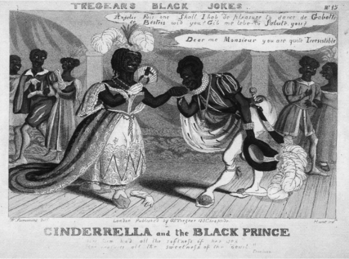
Cinderrella and the Black Prince, 1830
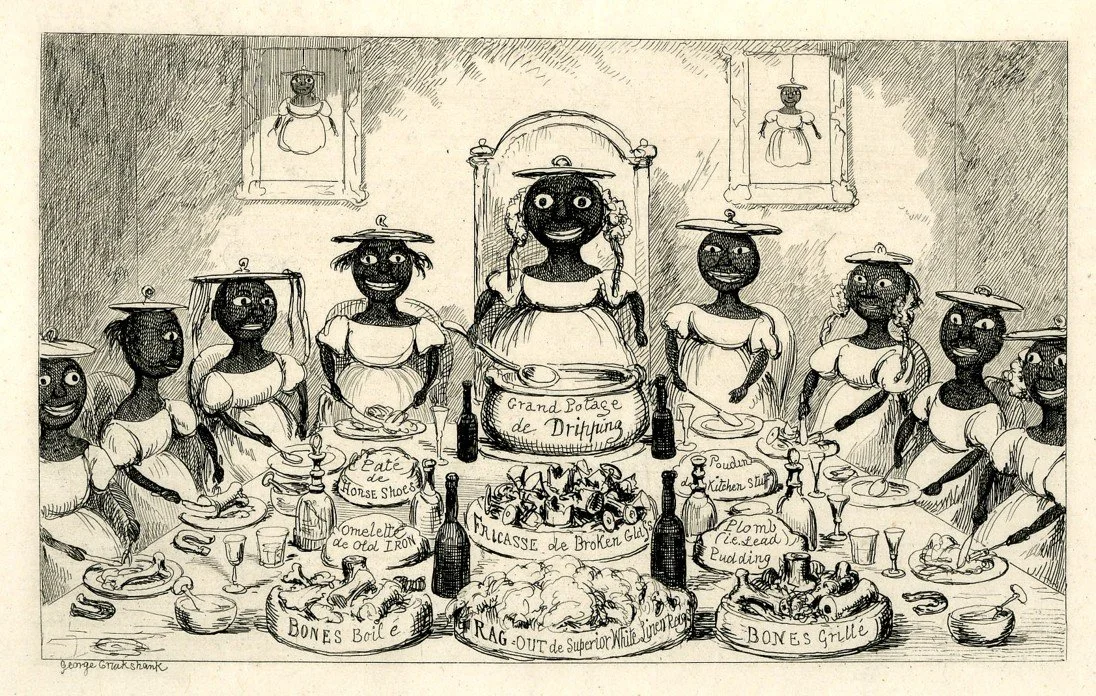
The Banquet of the Black Dolls, 1847
British national identity was shaped against racialised otherness prior to the arrival of blackface minstrelsy in 1836. As argued by Catherine Hall’s scholarship analysing British representations of colonies such as Jamaica, the British empire led to an equation of Britishness with Whiteness (Hall, 2024). This argument is supported by the satirical cartoon Cinderrella and the Black Prince, published in 1830 by William Summers, which demonstrates existing British attitudes towards race, with the comedic aspect of the cartoon stemming from the depiction of Black people as wealthy and noble (Cinderrella and the Black Prince, 1830). This attitude towards race is informed by both Britain's contemporary imperial ambitions and its historical exploitation of Black bodies through enslavement. The mockery of Black people in positions of wealth continued into the era of blackface minstrelsy in Britain, as demonstrated through The Banquet of the Black Dolls. This artwork, published in 1847 by George Cruikshank, illustrates “Black dolls” during a meal, with the content and names of what they are eating revealing their racial inferiority in the eyes of Cruikshank (The Banquet of the Black Dolls, 1847). The serving of bones as food implies that these “dolls” are animalistic, echoing historical connections between Black people and animals in British art (Frazier, 2019, p. 41). Furthermore, the naming of these foods including “poudin de kitchen stuff” connotes the perceived inferiority of Black people by mimicking the diets of wealthy Britons, whilst also connecting these “dolls” to the historic roles of Black women in domestic roles through British enslavement (Altink, 2007, p. 139). The similar depictions of Black people within both these pieces of art, despite a seventeen-year gap in publication date, demonstrates a continuity in British attitudes towards Black people which reinforced White, British national identity. This supports Colin Chambers, who argues that blackface minstrelsy “was thrilling and allowed the British to be very un-British without disturbing their sense of self and Britishness” (Chambers, 2011, p. 55). Chambers’s argument that Blackness was perceived as “un-British” signifies that Britishness was shaped against a racialised otherness, allowing blackface minstrelsy to represent what Britishness was not. Therefore, blackface minstrelsy reinforced the shaping of British national identity against Blackness.
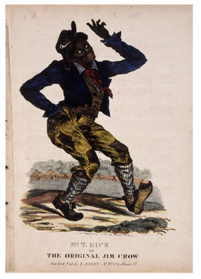
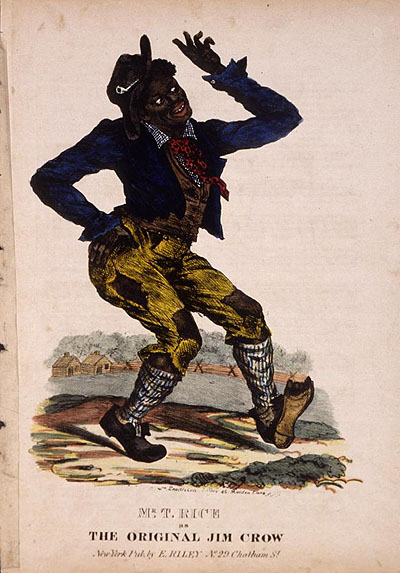
The Original Jim Crow, 1832
Blackface minstrelsy was imported from America but was shaped to be more appealing to British audiences. The above image portrays American blackface minstrel T. D. Rice performing as the character Jim Crow, whose arrival in Britain in 1836 led to the emergence of blackface minstrelsy as a popular form of entertainment throughout British society; transcending social divides such as geography and social class (The Original Jim Crow, 1832). The torn clothing of the Jim Crow character conveys his subordinate position through suggestions of poverty and labouring, while the exaggerated body movements became typical of blackface minstrel performances and connoted the subpar intelligence which many Britons associated with Black people (Ramsey-Kurz, 2007, p. 323). Furthermore, the landscape behind the Jim Crow character suggests a plantation environment, helping to pinpoint the character of Jim Crow as an African American and highlighting the initial influence which American minstrelsy had on the emergence of British blackface minstrelsy. Despite this American influence, Sarah Meer argues that minstrel performances were “tuned to London tastes,” exemplified through the changing of lyrics in song Jump Jim Crow to include “tailored topical allusions” which connected with British audiences by refering to contemporary news and culture (Meer, 2005, p. 151). Therefore, from the onset of British blackface minstrelsy in 1836, the content of performances was shaped by British audiences’ attitudes towards race, as well as a racialisation of Britishness as inherently White.
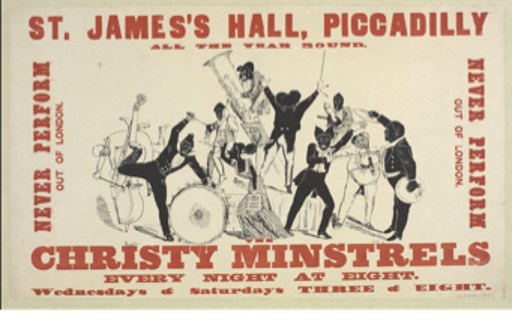
Christy Minstrels advertisement, 1857
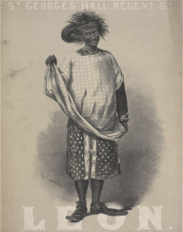
Patrick Francis Glassey in blackface, 1869
The exaggerated movements of the Jim Crow character would become synonymous with British blackface minstrelsy, as depicted in an 1857 advertisement for the Christy Minstrels (Poster Advertising the Christy Minstrels, 1857). The male character in the bottom left of the music ensemble illustrates the exaggerated movements typical of minstrel performances, while the large white space of his lips shows the exaggeration of body features used in minstrelsy. The minstrel's skin and clothing being the same shade of black reinforce the racial mockery intended of this performance. These performers are not simply performing as themselves with black faces, but they are performing how they believe a Black person would perform. Above is an image of Patrick Francis Glassey in his blackface minstrel character Leon (Poster Advertising Leon, 1869). Glassey's character is racialised not only through blackface, but also through torn and oversized clothing and footwear. His dishevelled hair and grabbing of his torn clothing solidify his racialisation by implying a lack of intelligence which many Britons associated with African Americans, as highlighted in Hilary Beckles’ scholarship (Beckles, 2021, p. 25; Ramsey-Kurz, 2007, p. 323). These stereotypical characterisations within British blackface minstrelsy reveal British stereotypes of Black people, with the evident racialisation reinforcing the belief in British superiority which existed prior to the blackface minstrel craze in Britain.
The shaping of British blackface minstrelsy around British culture highlighted political differences between Britain and America. Colin Chambers believes that British blackface minstrelsy exacerbated “a curious post-abolition sense of superiority over America” (Chambers, 2011, p. 53). This refers to the 1807 Act for the Abolition of the Slave Trade which prohibited Britain from continuing the trading of enslaved people, followed by the Abolition of Slavery Act in 1833 which offered some enslaved people in British colonies emancipation through work apprenticeships from August 1934 (excluding colonies controlled by the East India Company) (Hansford, 2024, p. 69). British political developments regarding slavery and, more importantly, how this diverged from the continued legality of American slavery, became a common topic within British minstrel performances as it reinforced audience belief in British moral superiority. This replicated the inclusion of slavery in other forms of entertainment before the arrival of blackface minstrelsy in Britain, with Tracy C. Davis arguing that “after 1833, the blackened performer reminded Britons of their firm sense of moral superiority on the slavery question” (Davis, 2013, p. 49). Davis's argument demonstrates the connection between British politics and national identity, with the precedent of Britishness being shaped against otherness leading to diverging political developments with America reinforcing British morals and identity. Similarly, Richard Waterhouse argues that within British minstrel performances, American support for slavery was mocked (Waterhouse, 1985, p. 4). This coincided with the abolition movement to end American slavery, which many in Britain viewed sympathetically and promoted within Britain. Most notably, the publication of Harriet Beecher Stowe's Uncle Tom's Cabin in 1852 became, according to Michael Pickering, “the abolitionists' touchstone,” selling one and a half million copies in Britain and British colonies in 1852 alone (Pickering, 2016, p. 23). According to Colin Chambers, the extreme popularity of Uncle Tom's Cabin amongst Britons “helped secure the acceptability of blackface minstrelsy” through perpetuating existing stereotypes of Black people as inferior to White Britons (Chambers, 2011, p. 54). Consequently, blackface minstrelsy reinforced Britain's sense of superiority through the nation's political handling of slavery, and how this contrasted to that of America, while substantiating existing belief in British racial superiority over Black people.
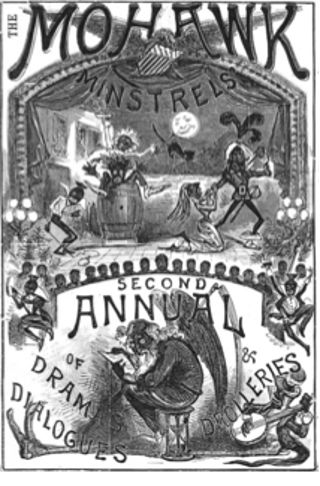
Annual of Drama, Dialogues and Drolleries, undated
This made American cultural references a core aspect of British minstrelsy. On the cover for sheet music containing “Favourite American Melodies” performed by Christy's Minstrels, the background includes flags displaying stripes and stars, overseen by a large eagle (Come Where My Love Lies Dreaming, 1857). Furthermore, song I Long For My Home in Kentuck places the performance in the state of Kentucky in the American south (Come Where My Love Lies Dreaming, 1857). These references to American culture imply that the performers are impersonating African American people through their blackface. Moreover, that America is referenced alongside blackface minstrelsy suggests it was viewed as similarly morally inferior to Britishness as Black people were, stemming from the moral superiority which many Britons felt due to British actions towards the abolition of the slave trade. This is shown by the cover of Mohawk Minstrels' Second Annual of Drama, Dialogues and Drolleries, which depicts blackface minstrel characters being overseen by an eagle carrying an American flag (Second Annual of Drama, Dialogues and Drolleries, undated). Violence is common within this image, with various characters brandishing swords, leading to expressions of fear on both humans and animals. Consequently, the frequent reference to American culture, and associating this with Black people, within British blackface minstrelsy demonstrates the superiority which Britons felt over America; a sentiment which became essential to many blackface minstrel performances in nineteenth-century Britain.
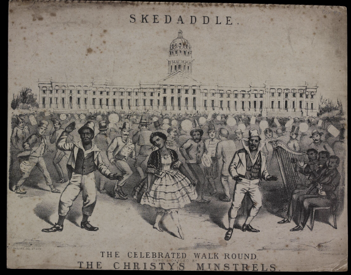
Skedaddle, mid-nineteenth century
The comparable inferiority of American and Black people within British blackface minstrelsy culminated in negative depictions of African American people. The cover of Skedaddle sheet music performed by Christy's Minstrels, published around 1850, depicts the troupe's blackface minstrel performers (Skedaddle, mid-nineteenth century). This sheet music includes the song Plantation Dance, with lyrics such as “We'll take um to our home de tambourine and bones / De banjo and de fiddle play'd in harmonious tones” (Skedaddle, mid-nineteenth century, p. 2). These lyrics demonstrate how minstrelsy shaped British imaginings of African American culture through connections to instruments used within minstrel performances. Furthermore, the representation of this character as African American is evidenced through lyrics “A darkies life's a merry one” (Skedaddle, mid-nineteenth century, p. 2). This implies a simplicity in the intelligence of African Americans through their seeming acceptance of and contentedness with the repressive and violent conditions they experienced through enslavement. Consequently, depictions of African Americans in British minstrelsy were influenced by a perceived British superiority over both Black people and America, stressed through references to America's continuation of slavery.
Not only were African Americans used to represent British superiority, but they were used to solidify existing belief in racial difference. A letter from Clare Fitzroy Kelly Bromley to her father back in England detail her experience watching a minstrel performance in New York, with Bromley writing that a “set of apparently black men, numbering from twelve to fourteen persons, and who impersonate the ‘darkies’; talk as they talk, sing as they sing” (Bromley, 1861, p. 49). Bromley's letter reveals belief in racial difference, with her language implying that Black people talk and sing differently to White people. However, it also reflects the exaggerated stereotypical performances of Blackness which Tom Scriven argues reflects the “archetype of Black people as dim-witted, oddly-framed and fundamentally comical” (Scriven, 2014, p. 94). Such racist attitudes are evident within the 1870 poem The Minstrel, where lyrics connect race and morality: “His blackened cheek, his dirty face / Proclaimed him vilest of his race” (Drake, 1870). These lyrics demonstrate an association between race and morality as the minstrel's Blackness is interpreted as proof of his immorality, with comparison to “his race” implying an inherent negativity of Blackness. This illustrates that representing African American people through minstrelsy reinforced audience belief in British superiority by promoting belief in racial difference.
Similarly, references to the British Empire within blackface minstrelsy reinforced British national identity. Colin Chambers highlights the connection between the British Empire and the content of entertainment in Britain during the nineteenth century, arguing that imperial expansion in India and Africa led to “theatre in the nineteenth century reflect[ing] a new notion of being British,” shaped around new colonial acquisitions (Chambers, 2011, p. 47). Praise of Britain's imperial strength is evident within the lyrics of song The Minstrel Boy from 1853, where lyrics “Thy soil should never breed a slave” praise British imperial strength (Watson, 1853). Additionally, that Britain “should never breed a slave” shows that national identity was shaped around British imperialism and its historical power in the enslavement of Black people. This was noted by Andrew Porter, as he reflected that the British Empire “markedly influenced” British “citizens' views of the outside world” (Porter, 1999, p. 1). Encouragement for British imperial expansion is evident within the songs written by prolific songwriter Harry Hunter, whose music was performed by minstrel groups such as the Mohawk Minstrels. For example, Fair Land of England lyrics include “Ocean surrounds thee, caresses thee, England; / Daughter and darling of fortune you are. / Neptune befriends thee, and blesses thee, England, / Bearing your children to conquer afar” (Hunter, Fair Land of England, 25 as cited in Pickering, 2016, p. 44). The imperial ambitions of England, but more widely Britain as a whole, are deemed natural within these lyrics, with the bearing of English children deemed as warranting the nation's imperial expansion. These references to the British Empire within British minstrelsy worked to reinforce the sense of superiority associated with Britishness amongst audience members, supporting Robert Nowatzki's argument that “minstrelsy could confirm ethnocentric British notions of their own superiority” (Nowatzki, 2010, p. 112).
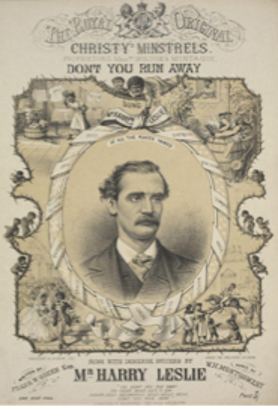
Don't You Run Away, late-nineteenth century
Likewise, Britain's imperial power is contrasted against other cultures through blackface minstrelsy, such as in the cover of sheet music Don't You Run Away, sung by Harry Leslie of Christy's Minstrels (Don’t You Run Away, late-nineteenth century). While this sheet music is undated, its title and depictions of Black people offer invaluable insights into British attitudes towards Black people and the perceived superiority of White Britishness. The various nude depictions of Black people, particularly children, implies an animalistic nature inherent based on race, contrasting to the suit and tie worn by White Briton Harry Leslie. This reveals the racial hierarchy of this illustration, which is symbolised through the central focus being Harry Leslie, surrounded by depictions of Black people experiencing violence through their impalement. Such violent portrayals echo the violence conducted by Britain when enslaving Black people, highlighting that despite the abolition of slavery in most British colonies by the mid-1800s, British attitudes towards Black people were unchanged and, instead, reinforced through depictions of British imperialism. Furthermore, the naming of places connected to the British Empire, such as Java and India, suggests that the representations of Black people within this illustration are symbolic of British attitudes towards all its colonised subjects. This supports Colin Chambers, who argues that minstrelsy allowed viewers to believe “if white can become black without losing its whiteness, white can conquer anything” (Chambers, 2011, p. 56). Consequently, depictions of empire within British blackface minstrelsy reinforced British national identity against colonised peoples and cultures.
To conclude, British blackface minstrelsy became popular in nineteenth-century Britain as it reinforced British national identity during periods of political upheaval. This was demonstrated through highlighting that blackface minstrelsy represented a continuation of Britishness being shaped against racialised otherness which occurred prior to the craze of British blackface minstrelsy. This article then considered how British national identity was reinforced through minstrelsy's evocation of American politics, stemming from blackface minstrelsy's American origins and Britain's divergence from America after British legislation to introduce abolition to most British colonies. Similarly, the role of blackface minstrelsy in reinforcing British national identity occurred through references to Britain's imperialism, where Britishness continued to be reinforced through depictions of perceived inferior imperial cultures and people. While this article focused on the period between 1830 and 1870, blackface minstrelsy remained a popular form of entertainment in Britain until the 1970s, as highlighted by Christine Grandy's scholarship on the Black and White Minstrel Show (Grandy, 2020). Analysis of the British political developments which occurred during the 1958 to 1978 lifetime of the Black and White Minstrel Show - in particular, political developments such as the 1962 Commonwealth Immigrants Act which restricted immigration following the Windrush generation of primarily Caribbean immigrants moving to Britain, and the subsequent politicised presence of Black people within British society - would reveal how minstrelsy reinforced British identities into the twentieth century. Such scholarship would provide critical contributions to the study of national identity in modern Britain.
Bibliography
Primary Sources
Victoria and Albert Museum Materials:
Christy’s Minstrels. Come Where My Love Lies Dreaming. London: The Musical Bouquet, 1857. Victoria and Albert Museum S.969-2014. https://collections.vam.ac.uk/item/O1293892/come-where-my-love-lies-sheet-music-foster-stephen/.
Christy’s Minstrels. Don't You Run Away. London: C. Sheard, Late-nineteenth century. Victoria and Albert Museum S.35-2012. https://collections.vam.ac.uk/item/O1242623/dont-you-run-away-music-green-frank-w/.
Christy’s Minstrels. Poster Advertising the Christy Minstrels. London: Unknown Publisher, 1857. Victoria and Albert Museum S.3997-1994.https://collections.vam.ac.uk/item/O1164695/poster/.
Concanen, Alfred. Poster Advertising Leon. London: Stannard, 1869. Victoria and Albert Museum S.3989-1994. https://collections.vam.ac.uk/item/O1164687/poster-alfred-concanen/.
Maguire, H.C. Skedaddle. London: Stannard, Mid-nineteenth century. Victoria and Albert Museum S.53-1989. https://collections.vam.ac.uk/item/O1156429/h-beard-print-collection-sheet-music-maguire-hc/.
Other Primary Source Materials:
Author Unknown. Mohawk Minstrels Magazine: Novelty Number 63. Undated. Classicbanjo.com. https://www.classic-banjo.com/files/JOURNALS_AND_ALBUMS/Mohawk_Minstrels_Magazine_No_63.pdf.
Bromley, Clara Kelly Fitzroy. A Woman's Wanderings in the Western World: A Series of Letters. London: Saunders and Otley. 1861. https://search-alexanderstreet-com.eux.idm.oclc.org/view/work/bibliographic_entity%7Cbibliographic_details%7C4188998#page/49/mode/1/chapter/bibliographic_entity%7Cdocument%7C4201582.
Clay, Edward Williams. The Original Jim Crow. New York City: E. Riley, 1832. https://upload.wikimedia.org/wikipedia/commons/8/86/Jimcrow.jpg.
Cruikshank, George. The Banquet of the Black Dolls. 1847. The British Museum 1978U.2857. https://www.britishmuseum.org/collection/object/P_1978-U-2857.
Drake, Ingalton R. “The Minstrel.” Parodies Regained. 1870. https://jstor.org/stable/60226606.
Watson, J. “The Minstrel Boy.” Words to Music. 1853. https://jstor.org/stable/60201745.
Secondary Sources
Altink, Henrice. Representations of Slave Women in Discourses on Slavery and Abolition, 1780-1838. New York: Taylor & Francis, 2007.
Beckles, Hilary. How Britain Underdeveloped the Caribbean: A Reparation Response to Europe's Legacy of Plunder and Poverty. Kingston: The University of the West Indies Press, 2021. https://ebookcentral.proquest.com/lib/ed/reader.action?docID=30678594&ppg=26&c=RVBVQg.
Booth, Michael R. Theatre in the Victorian Age. England: Cambridge University Press, 1991.
Bratton, J. S. Acts of Supremacy: The British Empire and the Stage, 1790-1930. Manchester: Manchester University Press, 1991.
Bratton, J. S. “English Ethiopians: British Audiences and Black-Face Acts, 1835-1865.” The Yearbook of English Studies 11 (1981): 127-142. https://www.jstor.org/stable/3506263?if_data=e30%3D&seq=1.
Chambers, Colin. “Aldridge and the Age of Minstrelsy.” Black and Asian Theatre in Britain. England: Routledge, 2011. https://doi.org/10.4324/9780203016541-3.
Davis, Tracy C. “‘I Long for My Home in Kentuck’: Christy’s Minstrels in Mid-19th-Century Britain.” TDR: Drama Review 57, no. 2 (2013): 38–65. https://doi.org/10.1162/DRAM_a_00260.
Frazier, Tony. “The Black Image in the English Gaze: Depictions of Blackness in English Art.” International Journal of Art and Art History 7, no. 2 (2019): 39-52. https://ijaah.thebrpi.org/journals/ijaah/Vol_7_No_2_December_2019/4.pdf
Grandy, Christine. “The Show Is Not About Race’: Custom, Screen Culture, and the Black and White Minstrel Show.” The Journal of British Studies 59, no. 4 (2020): 857-84. https://doi.org/10.1017/jbr.2020.125.
Hall, Catherine. Civilising Subjects: Metropole and Colony in the English Imagination, 1830-187. Cambridge: Polity, 2002.
Hall, Catherine. Lucky Valley: Edward Long and the History of Racial Capitalism. Cambridge: Cambridge University Press, 2024.
Hansford, Roger. “Sounding Slavery in the Victorian Drawing Room: The ‘Blackface’ Ballads of Philip Klitz.” Journal of Victorian Culture 29, no. 1 (2024): 64-85. https://doi.org/10.1093/jvcult/vcad013.
Julios, Christina. Contemporary British Identity: English Language, Migrants, and Public Discourse. England: Ashgate, 2008. https://ebookcentral.proquest.com/lib/ed/detail.action?docID=438744&pq-origsite=primo.
Meer, Sarah. Uncle Tom Mania: Slavery, Minstrelsy and Transatlantic Culture in the 1850s. Athens: University of Georgia Press, 2005.
Morrison, Kevin A. “Introduction: Jim Crow’s Tuxedo.” Political and Sartorial Styles: Britain and Its Colonies in the Long Nineteenth Century. Edited by Kevin A. Morrison. Manchester: Manchester University Press, 2023. https://www-cambridge-org.eux.idm.oclc.org/core/books/political-and-sartorial-styles/C9648F4B2FF92858D59AC611325A49E3
Nowatzki, Robert. Representing African Americans in Transatlantic Abolitionism and Blackface Minstrelsy. Baton Rouge: Louisiana State University Press, 2010.
Pickering, Michael. Blackface Minstrelsy in Britain. England: Routledge, 2016. https://doi.org/10.4324/9781315096247.
Pickering, Michael. “Mock Blacks and Racial Mockery: The ‘Nigger’ Minstrel and British Imperialism.” Acts of Supremacy. Edited by J. S. Bratton. United Kingdom: Manchester University Press, 1991.
Porter, Andrew. “Introduction: Britain and the Empire in the Nineteenth Century.” The Oxford History of the British Empire: Volume III, The Nineteenth Century. Edited by Roger Louis and Andrew Porter. Oxford: Oxford University Press, 1999. https://ebookcentral.proquest.com/lib/ed/detail.action?docID=886621&pq-origsite=primo.
Ramsey-Kurz, Helga. “Black Illiteracy Forged by Slavery and Racism.” The Non-Literate Other. America: Brill, 2007.
Schroeder-Lein, Glenna R. Lincoln and Medicine. Carbondale: Southern Illinois University Press, 2012.
Scriven, Tom. “The Jim Crow Craze in London’s Press and Streets, 1836-39.” Journal of Victorian Culture 19, no. 1 (2014): 93–109. https://doi.org/10.1080/13555502.2014.889426.
Vorachek, Laura. “Whitewashing Blackface Minstrelsy in Nineteenth-Century England: Female Banjo Players in 'Punch'.” Victorians: A Journal of Culture and Literature 123 (2013): 31-51. https://ecommons.udayton.edu/eng_fac_pub/6/.
Waterhouse, Richard. “The Internationalisation of American Popular Culture in the Nineteenth Century: The Case of the Minstrel Show.” Australasian Journal of American Studies 4, no. 1 (1985): 1–11. https://www-jstor-org.eux.idm.oclc.org/stable/41053377?sid=primo.