
The Negro Leagues’ Own Wichita Monrovians vs. Wichita Klan No. 6
On Sunday, June 21, 1925, 5,000 fans streamed into the Wichita Monrovians’ Island Park stadium in Wichita, Kansas. The all-wooden stadium was perched on Ackerman Island, a section of the Arkansas River that borders Wichita (in reality, more of a sandbar). The 102° Fahrenheit (39° Celsius) temperature didn’t do much to dissuade people from crossing the Douglas Street Bridge to watch the game. Today’s matchup against the Klan No. 6 was deemed too exciting to miss.
Baseball is often referred to as ‘America’s favourite pastime.’ The sport is so closely intertwined with the country’s social, political, and economic fabric that its games reflect the situations of the U.S. throughout history. Baseball’s long, sometimes-troubled history has the potential to help us understand America’s equally long and sometimes-troubled history. As American baseball pioneer and businessman Albert Spalding wrote in 1911, “To enter upon a deliberate argument to prove that baseball is our national game; that it has all the attributes of American origin, American character, and unbounded public favor in America, seems a work of supererogation. It is to undertake the elucidation of a patent fact; the sober demonstration of an axiom; it is like a solemn declaration that two plus two equals four” (Spalding 1911). This unique matchup between the Wichita Monrovians and Klan No. 6 reveals that race relations in 1920s Kansas were more complex than the traditional historical narrative would suggest; not all interactions between the Ku Klux Klan (also KKK or Klan) and their carefully selected foes were violent. This article interrogates the question of if baseball, ‘America’s favourite pastime,’ has the possibility to unite us all.
In 1920, after Major League Baseball officially refused to allow Black players into their league, Andrew ‘Rube’ foster founded the Negro National League (NNL) (Kelly n.d.). With teams across America’s midwest in Chicago, Cincinnati, Dayton, Detroit, Indianapolis, Kansas City, and St. Louis, the league’s slogan read: “We Are the Ship, All Else the Sea,” vowing to chart their own path in the segregated world of professional American sports. The Wichita Monrovians were a semi-professional team within this new Negro Leagues system.
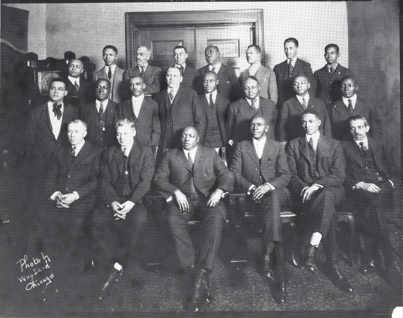
Rube Foster (front row, third from left) at the January 28, 1922 meeting of the Negro National League in Chicago, Illinois
Named in honor of Monrovia, Liberia, a colony established in the mid-1800s by the American Colonization Society for freeborn and formerly enslaved African Americans, the Wichita Monrovians joined the Colored Western League in June of 1922, finishing the season with an impressive 52-8 record (Pendleton 1997). After 1923, the Monrovians “barnstormed,” meaning they played a series of exhibition games in various spots (usually small towns) to showcase their skills as players of ‘America’s favourite pastime.’ The team often had a home field advantage, as they were one of the only all-Black organisations to have their own stadium thanks to their Black-owned business sponsor, the Monrovian Park Association.
In spring 1925, the Monrovians advertised in local newspapers that, “We’ll play anybody, it doesn’t matter, we’ll play white teams, Hispanic teams, Asian teams, Catholic teams, [or] Muslim teams” (Samson 2023). While it was not entirely unusual for barnstorming Negro Leagues teams to play all-White competitors, these matchips seldom occurred on the Black team’s home field, in major Northern cities (like Boston, Chicago, and New York), or anywhere in the South. Playing in front of majority-white audiences was similarly uncommon in these larger areas.
However, in smaller, more local areas, it appears that the norms of segregation were suspended on the diamond. Interestingly, advertising for interracial baseball competition was not only done by Black teams. The Southwest Cracker company ran an advertisement in an August 9, 1921 edition of the Wichita Beacon stating that they “would like to establish their claim to the city championship by meeting the best baseball club in the city. The Gold Medal Boys have an open date at the league park…and will play any club in the city….This pertains to all comers, white or black” (Wichita Beacon 1921).
These open calls for opponents do not mean that racial tensions weren’t running high in 1925 Kansas. In the mid-1920s, fueled by the distinctive Great War social and economic conditions, the Great Migration, and the emergence of widespread nativist sentiment, the KKK was on its second rise, determined to form an “Invisible Empire” of Protestant, moral, and patriotic citizens (Rives n.d.). In November of 1922, the Wichita Eagle published an article asserting that the local chapter of the KKK “support[ed] Jim Crow laws…[and] no employment of Negroes under any circumstances” (Pendleton 1997).
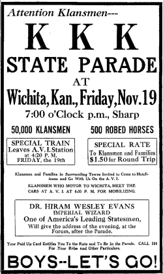
Advertisement from a November 17, 1926 issue of The Hutchinson News (Hutchinson, Kansas)
Though the state of Kansas legally outlawed the racist and prejudiced group in 1925, the organisation still had a deep and visible presence in the area, continuing to induct new members and publish their dedicated newspapers, like The Independent, a weekly paper published in Mulberry, KS. (Sloan 1974). Its existence was heavily debated in the press, especially during the 1924 gubernatorial race, since leading anti-Klan newspaperman William Allen White was in the running.Under these circumstances, a Wichita KKK chapter wanted to counter the anti-Klan narrative being forwarded by politicians and in the press by organising an event “for everybody in the community.” Their interest was piqued by the Monrovians’ call to “play anybody” (Samson 2023).
With this additional context, we can return to June 21, 1925 at Island Park Stadium. According to the Wichita Beacon, as those 5,000 fans entered the ballpark, officials carefully searched their bags and pockets for “strangle holds, razors, horsewhips, and other violent implements of argument” (Wichita Beacon 1925). Not exactly what you’d usually bring to a baseball game, but then again, this wasn’t your usual game.
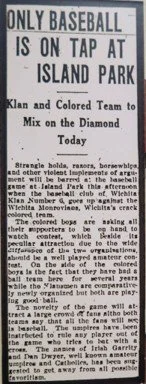
June 21, 1925 article in the Wichita Beacon. Photo taken of panel by author at the Negro Leagues Baseball Museum (Kansas City, Missouri) in October 2015
As you might have guessed by now, Wichita Klan No. 6 was a semi-professional baseball team made up of Ku Klux Klan members. To complicate matters further, the notoriously racist organisation was set to play an all-Black team. You can see how security might have to be tighter, can’t you? Oh, and a special rule was in place: anyone who stepped up to the plate with a cross and not a bat would be thrown out.
But regardless of any apprehension, the game got off to a solid start. Umpires W.W. ‘Irish’ Gerrity and Dan Dwyer were selected because they were white and Catholic, a decision intended to demonstrate fairness, since they represented another group historically disliked by the KKK. A pre-game publication on June 21 by the Wichita Beacon noted that these “well known amateur umpires” were chosen “to get away from all possible favoritism” (Wichita Beacon 1925). The first five innings were a pitcher’s duel with a score of 1-1, meaning the pitching was so good that batters were having a tough time making contact and therefore scoring. The last four innings produced a flurry of runs, with the Wichita Monrovians beating their Klan No. 6 challengers 10-8.
Now, I can’t tell you what was going through the players’ minds, especially since the roster is largely lost to history. We do, however, know that Lascelle Dortch managed the Monrovians, and his lineup featured Thomas Jefferson ‘T Baby’ Young and Walter Lee ‘Newt’ Joseph, both of whom would go on to have careers with the famed Negro Leagues team the Kansas City Monarchs (Baseball Reference n.d.). But, most likely, the Monrovians were thrilled to have proved their superiority on the field. I can only imagine they hoped to change some Klansmen’s minds about Black Americans. The fact that I have few historical records to share with you about the game suggests that the matchup was restricted to the diamond–no serious brawls broke out off the field.
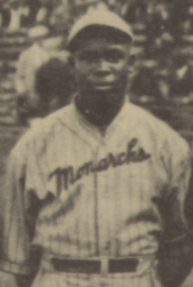
Newt Joseph at the 1924 Colored World Series
So what?–a Negro Leagues team beats a Ku Klux Klan team. This game demonstrates more than the fact that the Wichita Monrovians were a better baseball team than the KKK players. The team’s name implies that the organisation was popular enough in Wichita such that members did not need to hide their identity behind those white cone-shaped hoods–they played a public baseball game as Klansmen.
Racial tensions of 1925 Wichita, Kansas were transposed onto Island Park Stadium on June 21. But, perhaps shockingly to a twenty-first-century audience, no violence broke out. The two teams–and their fanbases–respected each other enough to compete in a game that didn’t bleed off the field. Although we would be remiss if we did not acknowledge that the lack of violence is likely due, in part, to the Klan’s propagandic desire to give the impression that its members were not racist thugs. Interestingly, newspaper coverage of the “best attended and most interesting game in Wichita” is overwhelmingly positive, even if it is fairly minimal (Wichita Beacon 1925). Perhaps this can be attributed to the fact that though matchups of all-Black and all-White teams were not uncommon, the previous all-White teams were not representing a racially charged organization.
Though the Monrovians partook in interracial games almost from their conception as a team, it does not appear that previous games had as much newspaper coverage as the matchup on June 21. That is not to say the games were unpopular. An August 28, 1922 article in the Wichita Beacon notes that a matchup between the Monrovians and the all-White Campbell Merit Bread Company drew “one of the largest crowds to ever attend a game at Monrovia park…which consisted of both white and colored fans” (Wichita Beacon 1922). Once again, we can see that the often black-and-white narrative of racial intolerance in interwar Kansas is far more complex than it appears.
As historian Jason Pendleton posits, “the almost inexplicable presence of an all-black team playing against the historical archenemy of African Americans suggests that Wichitans were developing an attitude of toleration toward African Americans in the area of baseball that was inconsistent with the pervasive racist segregation that dominated American society” (Pendleton 1997). I’d be inclined to agree. While it’s not likely that everyone in Wichita was as open-minded as this well-attended, nonviolent June 1925 matchup (and the few aforementioned similar interracial games) may make it seem, it is clear that the baseball diamond provided grounds for burgeoning racial tolerance, acceptance, and respect.
Perhaps baseball–‘America’s favourite pastime’–has the potential to unite us all.
Bibliography
Carroll, Brian. "Beating the Klan: Baseball Coverage in Wichita before Integration, 1920–1930." Baseball Research Journal, 2008. https://sabr.org/journal/article/beating-the-klan-baseball-coverage-in-wichita-before-integration-1920-1930/.
Kelly, Matt. "The Negro National League is Founded." National Baseball Hall of Fame. https://baseballhall.org/discover-more/stories/inside-pitch/negro-national-league-is-founded.
"The Monrovians Vs. The Klan." Video. YouTube. Posted by Chuck Brodsky, August 22, 2015. https://www.youtube.com/watch?v=jAEHBOl9-kI.
"Newt Joseph." Baseball Reference. https://www.baseball-reference.com/bullpen/Newt_Joseph.
Office of the Historian, United States Department of State. “Founding of Liberia, 1847.”
Milestones in the History of U.S. Foreign Relations. https://history.state.gov/milestones/1830-1860/liberia.
Pendleton, Jason. “Jim Crow Strikes Out: Interracial Baseball in Wichita, Kansas, 1920-1935.”
Kansas History 20 (1997): 86-101. https://www.kansashistory.gov/publicat/history/1997summer_pendleton.pdf
Rives, Timothy. "The Second Ku Klux Klan in Kansas City: Rise and Fall of a White Nationalist Movement." The Pendergast Years. Center for Midwestern Studies at the University of Missouri-Kansas City. https://pendergastkc.org/articles/second-ku-klux-klan-kansas-city-rise-and-fall-white-nationalist-movement.
Samson, Brendan. "Wind Surge Pay Tribute to Wichita's Baseball Roots: Twins Affiliate Changes Identity to the Monrovians for Special Game." Minor League Baseball. MLB Advanced Media. Last modified August 9, 2023. https://www.milb.com/news/wichita-wind-surge-honor-monrovians-with-special-night.
Sloan, Charles William, Jr. "Kansas Battles the Invisible Empire: The Legal Ouster of the KKK from Kansas, 1922-1927." The Kansas Historical Quarterly 40, no. 3 (1974): 393-409. https://www.kancoll.org/khq/1974/74_3_sloan.htm.
Spalding, Albert. America’s National Game. American Sports Publishing Company, 1911. https://ia801307.us.archive.org/23/items/cu31924029949579/cu31924029949579.pdf.
Wichita Beacon. “For the City Title.” August 9, 1921.
Wichita Beacon. “Monrovians Won Two Games from Campbell Bread.” August 28, 1922.
Wichita Beacon. “Only Baseball Is on Tap at Island Park.” June 21, 1925.
"Tom Young." Baseball Reference. https://www.baseball-reference.com/bullpen/Tom_Young.
"The Wichita Monrovians." Video. YouTube. Posted by Alyssa Pfeifer, December 8, 2023. https://www.youtube.com/watch?v=tAI-_uCb7fg.
Further Reading, Listening and Viewing
Reading:
Brian Carroll, “Beating the Klan: Baseball Coverage in Wichita before Integration, 1920-1930,”published in 2008’s Baseball Research Journal, https://sabr.org/journal/article/beating-the-klan-baseball-coverage-in-wichita-before-integration-1920-1930/.
Brendan Samson, “Wind Surge Pay Tribute to Wichita's Baseball Roots: Twins Affiliate Changes Identity to the Monrovians for Special Game”, https://www.milb.com/news/wichita-wind-surge-honor-monrovians-with-special-night.
Listening:
“The Monrovians Vs. The Klan” song by Chuck Brodsky, https://www.youtube.com/watch?v=jAEHBOl9-kI.
Watching:
The Wichita Monrovians short documentary by Alyssa Pfeifer, released December 8, 2023, https://www.youtube.com/watch?v=tAI-_uCb7fg.
Note: Unless otherwise stated, all images used are in the public domain. Please contact the author if you have questions or concerns.