

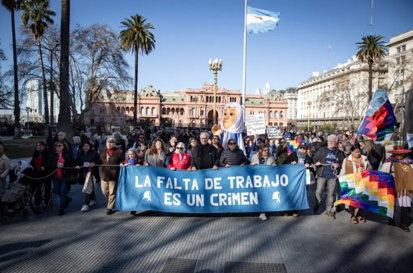
Communication With Mothers, March No.2520 of the Mothers of Plaza de Mayo, 2026. https://madres.org/marcha-n-2520-de-las-madres-de-plaza-de-mayo/
On Thursday 30 July 2026 at 3:30 pm, in front of the Casa Rosada, March No. 2520 of the Mothers of Plaza de Mayo took place. Almost five decades after their first demonstration, the mothers continue to march in pursuit of truth, justice, and memory for the victims of Argentina’s ‘Dirty War’.
“Fuelled by anger at the disappearance of their children and by an extraordinary courage” (Bouvard, 1994), on 30 April 1977, fourteen women gathered in the Plaza de Mayo in Buenos Aires to demand answers. Their children had disappeared, taken by state security forces as part of a campaign of political repression that defined Argentina’s military dictatorship between 1976 and 1983. There were no public records, or even acknowledgement of their whereabouts. It began as mothers searching for their children, but their weekly demonstrations, distinctive headscarves and refusal to accept silence, shifted their personal suffering into political resistance.
The significance of these demonstrations is elevated by the way they challenged traditional expectations about gender and political participation. The military dictatorship promoted an ideology that encouraged women to focus on domestic responsibility, and discouraged women from engaging with political life. By publicly demanding action in the Plaza de Mayo, the mothers subverted the regime's own values and generated a paradox. They weaponised motherhood, the very identity the regime deemed fundamentally apolitical and it became a mechanism to undermine state authority. They transformed a traditionally private role into a public form of resistance. Their movement demonstrates that political power is not always created by abandoning traditional identities, but can emerge through their reinterpretation. They wanted answers about their children, whom they were expected to care for - a demand that was difficult to criticise.
Contextually, the military dictatorship, known officially as the National Reorganisation Process (Proceso de Reorganización Nacional), occurred following the military coup on 24 March 1976. A series of military juntas overthrew the government, banned political parties, and kidnapped and killed an estimated 30,000 people suspected of opposing them. This figure, although widely used by human rights organisations, is contested (Furtado, 2015). The National Commission on the Disappearance of Persons (CONADEP), published findings in 1984 using the title Nunca Más (never again). The report documents a total of only 8,960 confirmed disappearances whilst also stating the final total was almost certainly higher. (CONADEP, 1986)
General Suárez Mason, a senior officer who was later arrested, was believed to have “signed 'fifty to a hundred death warrants per day' over a long period" (Osorio , 2002).
The junta attempted to control opposition through censorship, imprisonment, and torture. They targeted anyone who opposed or threatened them, including activists and journalists. There are also cases of pregnant women being detained and giving birth before they were murdered, then their children were illegally adopted. An estimated 500 children and infants were stolen in Argentina (Lessa & Balardini, 2024). Kidnappings happened at night, as well as in broad daylight, to serve as a deliberate public deterrent, in order to terrorise the rest of the population into silence. When the Mothers of Plaza de Mayo began gaining media attention, they were also targeted. Esther Ballestrino de Careaga, who was a biochemist and teacher, became a founding member after her pregnant daughter, Ana María, was targeted. “She was thrown from a plane that left the city’s airport on the night of 14 December 1977…Careaga’s body, Léonie Duquet, and two other mothers, Azucena Villaflor and María Bianco, washed ashore six days later and were buried in a common grave. Their remains were only identified via DNA testing in 2003” (Goñi, 2017). The regime clearly felt threatened, thus it took action; this highlights the significance of their protests.
Prior to the coup, the wider political landscape was shifting. For example, Eva Perón, who founded the female political party, Partido Peronista Femenino, advocated for the working class and was a key leader in securing Law 13,010 in 1947. This resulted in establishing legal political equality and gaining women’s suffrage (Deiner, 1973). By 1974, Argentina saw its first female President with Isabel Perón. However, the institutional structures of Argentina continued to be deeply patriarchal. There was a strict divorce ban and legal frameworks such as patria potestad, which designated fathers as head of the household, including legal control over children and family assets (Guy, 1985). This severely limited female economic and legal independence. In 1974, the sale and promotion of birth control pills were banned and abortions were heavily criminalised (Barrancos, 2006). These measures functioned to restrict women’s control over their own bodies. Groups such as Unión Feminista Argentina and the Movimiento de Liberación Femenina campaigned for the decriminalisation of abortion and access to free contraceptives.
Following the coup, the dictatorship continued to weaponise these limitations, and used state propaganda within media and school legislations “to restore what the military considered as traditional Argentine values” (Juárez-Dappe, 2022). Society still strongly expected women to fulfil domestic roles within a patriarchal unit. It remained their assumed duty. This rigid enforcement did ultimately backfire on the dictatorship as it fuelled underground feminist networks and inadvertently allowed the grieving mothers to enter a public space. Their identity as mothers gave them a moral authority that allowed them to challenge the state while appearing to defend, rather than reject, traditional family values.
The first demonstration of the mothers was driven by a desperation for information as they were met with silence by government officials. By gathering in front of the Casa Rosada (the presidential palace), they maintained strategic visibility and placed private grief at the centre of national debate. “While the military outlawed other forms of social protest, they initially allowed the mothers to march because the government dismissed them as ‘locas’ (madwomen) rather than viewing them as a legitimate threat” (Sharnak & Moore,2025). The junta that “legitimated its mission with the rhetoric of Christian and family values, could hardly gun down defenceless mothers in public”(Taylor, 2001). They utilised the regime's own patriarchal condescension, which strategically transformed a dismissive gender bias into a vital opening for political resistance.
After the coup, the Full Stop Law (1986) and Due Obedience Law (1987) essentially halted trials and blocked prosecution of military personnel. These were later revoked, and in 2005, over a thousand military men were prosecuted for human rights violations. “The laws of impunity function to silence the history of the dictatorship and the mothers movement counters this silencing by invoking the memory of the disappeared and by critiquing the state, past and present” (Burchianti, 1994).
Their marches have become a powerful symbol of resistance. Many women carried photographs of their missing loved ones and banners calling for justice. Their white headscarves began as cloth nappies to symbolise the missing children, motherhood and purity. Many have the names of those missing, as well as exactly when they disappeared. These headscarves became internationally recognised and became the movement's symbol. Their effectiveness clearly threatened the state, as highlighted by the eventual murders of several mothers. Hebe de Bonafini, who was a co-founder of the group, stated: "They arrested us, they beat us, we came with wigs so they couldn't identify us" (Maishman, 2022). Even today, the online website for the Mothers of Plaza de Mayo continues to detail each of the marches and highlights those who are missing. Additionally, its sister website, the Grandmothers of Plaza de Mayo, details a search for grandchildren who were stolen at birth and had their identities stripped. The mothers began marching in 1977 as a desperate plea but their protest has evolved into a multigenerational network in which motherhood remains a force that continues to stand up to state power.
A significant aspect of the movement was their transformation of motherhood into a political identity. They stepped out from typical domestic and submissive expectations to have a political voice. They demonstrated that maternal responsibility could extend beyond the household and into public life. Their activism did not emerge from a rejection of motherhood, but from a belief that being a mother gave them both the responsibility and the authority to demand justice. Their protest was focused on gaining answers about their children. However, the consequences of their actions challenged existing gender boundaries. By entering public spaces, confronting government officials, and speaking internationally, they expanded the possibilities of women’s political participation. Therefore, the mothers reveal the complexity of gender and resistance. They used motherhood as a socially accepted identity to pursue an action that threatened the dictatorship. They were publicly questioning state authority.
“As women who defined themselves both as mothers and as revolutionaries, they saw no contradiction between these roles” (Bouvard, 1994). This is a powerful message to send to women living in a patriarchal world that consistently attempts to silence them.
They demonstrate that resistance does not always emerge through complete rejection of existing social structures. Instead, protest can challenge power by transforming the meanings attached to familiar identities. This aligns with Elshtain's argument that a feminist politics can be built on "maternal thinking" (Elshtain, 1982), rather than a rejection of it, as using care and responsibility for others is a legitimate basis for public discourse and resistance. However, this framework remains a point of contention amongst feminist scholarship as the mothers faced “criticism for inhabiting, emphasising and exploiting the traditional role of women which feminists were striving to deconstruct” (Howe, 2006). Although it is this tension that aided their undermining of the regime. By presenting themselves as mothers seeking justice for their children, they exposed the contradiction between the dictatorship’s public commitment to family values and its responsibility for widespread human rights abuses.
In conclusion, the case of the Mothers of Plaza de Mayo demonstrates that political resistance does not need to involve the rejection of traditional identities, but may instead be generated through their strategic reinterpretation. By transforming motherhood from a private, depoliticised role into a public act of defiance, the mothers exposed the internal contradictions of the dictatorship's own ideology. They presented themselves as mothers demanding answers about their children and utilised the patriarchal culture that underestimated women by using that societal bias to their advantage.
Their weekly demonstrations, their use of the headscarf as a collective symbol, and their refusal to accept official silence all illustrate that maternal identity, rather than being incompatible with political agency, can be a valuable instrument of defiance. The continued activism of the mothers highlights that turning motherhood into a political force was a permanent transformation of women's political identity. It was not a temporary tactic, as their identities have shifted.
Overall, the mothers have proved that personal grief can easily cross the line to become a powerful, public weapon against state terror. Furthermore, by reclaiming feminine expectations, the Mothers of Plaza de Mayo proved that domestic identities can become a powerful and lasting form of resistance against state power.
Bibliography
Abuelas de Plaza de Mayo, Accessed 28 July 2026. https://www.abuelas.org.ar/
Barrancos, Dora. "Problematic modernity: gender, sexuality, and reproduction in twentieth-century Argentina." Journal of Women's History 18, no. 2 (2006): 123-150.
Blackwill, Alexandria. The Influence of the Mothers of the Plaza de Mayo on Contemporary Feminist Movement in Argentina, Ni Una Menos, 2022.
Bouvard, Marguerite Guzman. Revolutionizing motherhood: The mothers of the Plaza de Mayo. London: Bloomsbury Publishing PLC, 1994.
Burchianti, Margaret E. “Building Bridges of Memory: The Mothers of the Plaza de Mayo and the Cultural Politics of Maternal Memories.” History and Anthropology 15, no. 2 (2004): 133–50. doi:10.1080/02757200410001689954.
CONADEP (Comisión Nacional sobre la Desaparición de Personas). Nunca más: the report of the Argentine National Commission on the Disappeared, 1986. archive.org. https://archive.org/details/nuncamsreportofa0000arge/page/284/mode/2up?q=8%2C960
Deiner, John T. “Eva Perón and the Roots of Political Instability in Argentina”, Civilisations no.23 (1973): 195–212. http://www.jstor.org/stable/41229515.
EBSCO, “Argentine Leaders Are Convicted of Human Rights Violations”. https://www.ebsco.com/research-starters/history/argentine-leaders-are-convicted-human-rights-violations
Edwards, Pearce, Jennifer Gandhi, and Donald Grasse. "Fixing the past: The effects of human rights trials on political attitudes in Argentina." British Journal of Political Science 55 (2025) 45-68.
Elshtain, Jean Bethke. “Feminist Discourse and Its Discontents: Language, Power, and Meaning.” Signs 7, no. 3 (1982): 603–21. http://www.jstor.org/stable/3173857.
Feitlowitz, M. “A Daughter of the Disappeared.” The Women’s Review of Books, no. 10/11 (1993). 7–8. https://doi.org/10.2307/4021520
Fisher, Josephine. Mothers of the Disappeared. Boston: South End Press, 1989.
Furtado, Henrique Tavares.“Against State Terror: Lessons on Memory, Counterterrorism and Resistance from the Global South.” Critical Studies on Terrorism 8, no.1 (2015): 72–89. doi:10.1080/17539153.2015.1005936.n
Guy, Donna J. "Lower-class families, women, and the law in nineteenth-century Argentina." Journal of Family History 10, no. 3 (1985): 318-331.
Howe, Sara Eleanor. "The Madres de la Plaza de Mayo: asserting motherhood; rejecting feminism?." Journal of International Women's Studies 7, no. 3 (2006): 43-50.
International Commission on Missing Persons, "Where Are the Missing?" (2026) https://icmp.int/the-missing/where-are-the-missing/argentina/
Jelin, Elizabeth. State repression and the labors of memory. Vol. 18. U of Minnesota Press, 2003.
Juárez-Dappe, Patricia. “Family Canon: The Politics of Family during the Last Civic-Military Dictatorship in Argentina, 1976–83.” Journal of Latin American Studies 54, no. 1 (2022): 79–101. https://doi.org/10.1017/S0022216X21000778.
Lessa, Francesca. The Condor Trials : Transnational Repression and Human Rights in South America. New Haven: Yale University Press, 2022.
Lessa, Francesca, and Lorena Balardini."No safe haven: Operation Condor and transnational repression in South America." International Studies Quarterly 68, no. 2 (2024): 112-130.
Lloyd-Roberts, Sue, “Argentine grandmothers determined to find 'stolen' babies”, BBC News, (2013)https://www.bbc.co.uk/news/world-22004491
Madres de Plaza de Mayo, Accessed 28 July 2026, https://madres.org/
Madres de Plaza de Mayo, “March No.2520 of the Mothers of Plaza de Mayo”, Communication With Mothers, 2026.https://madres.org/marcha-n-2520-de-las-madres-de-plaza-de-mayo/
Maishman, Elsa. “Hebe de Bonafini: Co-founder of Argentina's Plaza de Mayo mothers group dies at 93”, BBC News, 2022. https://www.bbc.co.uk/news/world-latin-america-63697367
Mosse, Kate. Feminist History for Every Day of the Year. London: Macmillan, 2025.
Navarro, Marysa. “The Case of Eva Perón.” Signs 3, no. 1 (1977): 229–40.http://www.jstor.org/stable/3173094.
Osorio, Carlos, ed. State Department Opens Files on Argentina's Dirty War: New Documents Describe Key Death Squad Under Former Army Chief Galtieri. National Security Archive Electronic Briefing Book No. 73, 2002. https://nsarchive2.gwu.edu/NSAEBB/NSAEBB73/index.htm
Phillips, Tom, and Goñi, Uki. "Argentina’s Far-Right Frontrunner Reopens Wounds of Dictatorship."The Guardian, 2023.https://www.theguardian.com/world/2023/oct/19/argentina-javier-milei-dictatorship-presidential-election
Robbins, Corinne J. "A Movement in Process: The Effects of Post-Dictatorship Politics on the Legalisation of Abortion in Argentina.",Connecticut College, 2025.
Scott, Joan Wallach. Gender and the Politics of History. Columbia University Press, 1999.
Sharnak, Debbie, and Gillian Moore. "Protection-based advocacy: assessing the United States Friends of the Mothers of the Plaza de Mayo." Cold War History (2025): 1-20.
Taylor, Diana. "Making a spectacle: The mothers of the Plaza de Mayo." Journal of the Motherhood Initiative for Research and Community Involvement, 2001.
The National Security Archive, “Document 7: Subject: Efforts to Account for the Disappeared”, May 10, 1979. https://nsarchive2.gwu.edu/NSAEBB/NSAEBB73/790510.pdf
Uki, Goñi,“Argentina 'death flight' pilots sentenced for deaths including pope's friend”, The Guardian,2017.
(Note: Right Image Cover: By Archivo Hasenberg-Quaretti - Own work, CC BY-SA 3.0, https://commons.wikimedia.org/w/index.php?curid=27392322)